Who should choose the model?
OpenCodex, Magpie, and rulesync separate three concerns that are easy to blur: API translation, provider routing, and portable agent instructions.
Tools in this story
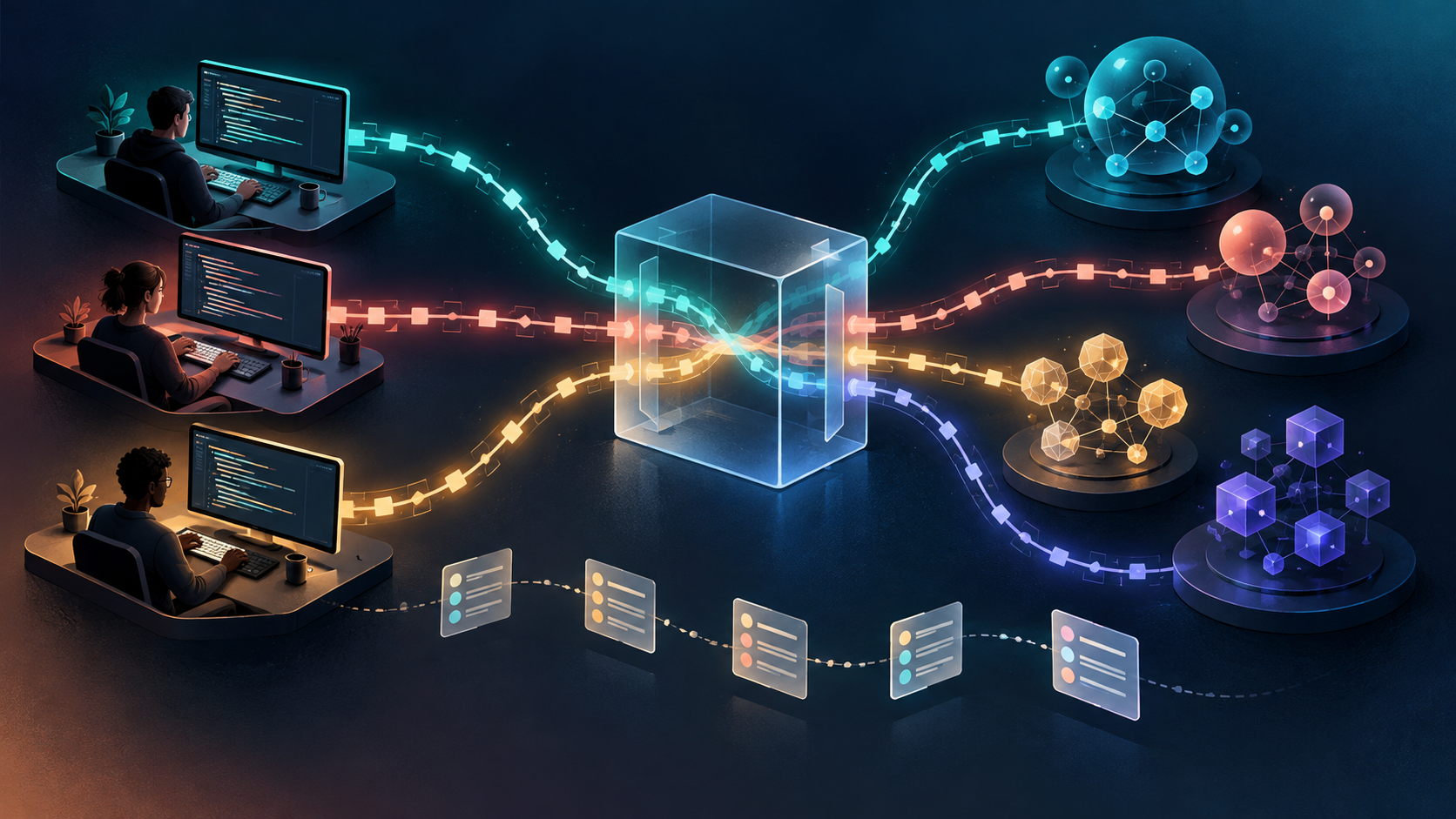
A gateway arrives between tool and model
Coding agents usually begin with a simple pairing: one client, one vendor, one account. That simplicity erodes when a developer wants a local model for private work, a hosted model for difficult tasks, or the same provider behind several clients. OpenCodex inserts a local gateway at that boundary. Its documentation says it accepts the OpenAI Responses and Chat Completions APIs plus Anthropic Messages, then translates requests into the protocol a configured provider expects. Codex, Claude Code, Claude Desktop, and other supported tools can keep their familiar interfaces while the gateway manages providers and models.
The project is genuinely new rather than merely new to Homebrew. Its first upstream release, v0.1.0 in June 2026, called itself the initial release and documented the first proxy, adapters, configuration injection, model router, and dashboard. That history matters because the package is moving quickly: a wide support matrix today is evidence of ambition, not a substitute for long operational experience.
What the local hop actually changes
The documented personal workflow is short: install the CLI, run ocx start, and open the dashboard on the local port. ocx service moves the gateway into the background. From there, a user adds providers, chooses models, and lets OpenCodex maintain supported client configurations. The useful abstraction is not merely “another model picker.” It is a translation and routing layer that can keep multiple clients pointed at one locally managed endpoint.
That layer also becomes a trust boundary. Provider keys, prompts, tool calls, logs, and account state may pass through it. A local process is not automatically a harmless process. Before using it with production repositories, confirm where credentials are stored, which interface the service binds to, what the dashboard exposes, and whether logs retain sensitive request content. API compatibility deserves equally practical testing. Streaming, cancellation, reasoning traces, images, and tool calls can differ across clients and providers; the project itself qualifies support according to what each combination can carry.
A disciplined trial can stay small:
- Use a disposable repository and one provider account.
- Route one supported client through the gateway and test plain chat, tool calls, cancellation, and a failed request.
- Inspect the generated client configuration and the gateway logs.
- Rotate the credential, restart the service, and verify what state persists.
- Add a second model only after the first route behaves predictably.
These checks establish actual behavior without treating catalog installation activity as evidence of reliability or unique users.
Magpie chooses routes; rulesync carries intent
Magpie tackles overlapping routing work through a broader cross-platform application. Its upstream guide describes desktop, terminal, web, TUI, Docker, and Termux surfaces. A user can select models for supported agents, configure provider accounts or subscription logins, and build fallback groups. When a quota is exhausted, Magpie can move to another account or route; with no fallback configured, the error reaches the agent. Optional local masking can replace keys, passwords, and email addresses before a request leaves the machine, but the documentation is explicit that masking is off by default.
That makes Magpie attractive for people who want a visible control plane and account failover. It also makes model identity less static. An automatic fallback can keep work moving while changing the model that completes it, which may affect style, tool behavior, cost, or reproducibility. Teams should record routing choices alongside important evaluations instead of assuming the client name identifies the model.
Rulesync works at a different layer. It does not proxy requests or manage provider credentials. It starts from unified rule files and generates configuration for multiple AI development tools. The outputs are ordinary files that teams can commit and review. Pairing rulesync with a gateway can therefore separate what the agent should know from which model receives the request. That separation is clean only if generated files are reviewed: different clients interpret instructions, scopes, and precedence differently, so identical source text does not guarantee identical behavior.
Choose the smallest boundary that solves the problem
For one client and one provider, direct configuration remains the easiest system to understand. OpenCodex becomes compelling when API translation and managed client configuration remove repeated work. Magpie fits users who value a graphical cross-platform control surface, multiple accounts, and explicit fallback routes. Rulesync helps when the recurring pain is duplicated repository guidance rather than model access.
Whichever boundary is chosen, keep the failure path visible. Know how to stop the local service, revoke its credentials, bypass it, and reproduce a task against the provider directly. A gateway can make model choice flexible, but the durable engineering gain comes from making that choice observable, reviewable, and reversible.