ccmux: The Attention Router for Coding Agents
When several agents work in parallel, the scarce resource is no longer terminal space—it is knowing which session needs a human next.
Tools in this story
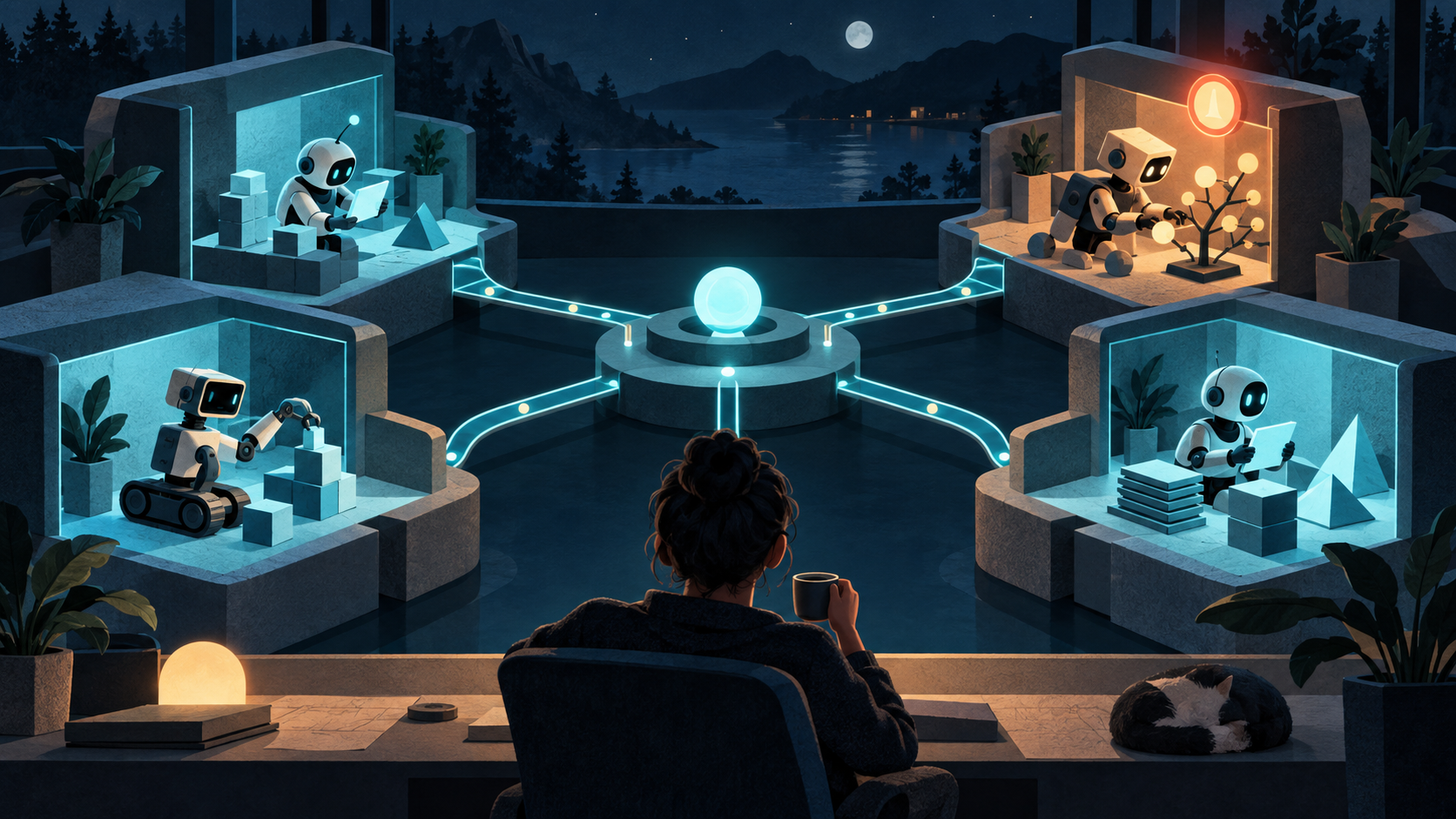
Parallelism creates an attention problem
Opening another coding-agent session is easy. Remembering which of four sessions is compiling, waiting for approval, asking a question, or ready for review is harder. ccmux treats that as a routing problem for human attention. It runs alongside tmux, observes supported agent sessions, and presents their state in a single terminal interface. Instead of cycling through panes to rediscover what each agent is doing, the operator can start with the session that is blocked.
That boundary matters. ccmux does not replace the coding agents, Git, or tmux. Its documentation describes support for several agent CLIs and a daemon that watches existing sessions. The dashboard can group work by repository, show working or waiting state, surface diffs and pull-request checks, and send notifications. Worktree creation and spawning help start another task, while handoff features can pass context from one agent to another. The value is coordination around tools developers may already use.
A new project with a concrete workflow
The first tagged ccmux release, v1.0.0, appeared on July 6, 2026. That makes it genuinely new rather than an old project newly packaged by Homebrew. Its young age should shape expectations: agent output formats change, integrations can lag, and a status classifier that works well in the author's setup may meet unfamiliar prompts or terminal layouts elsewhere. A trial should use disposable branches before the dashboard becomes the team's control surface.
There is useful evidence beyond the feature list, though not yet evidence of broad adoption. An independent write-up describes coordinating three or four agents across multiple machines, checking sessions from a phone, and returning directly to those needing intervention. That is one practitioner's account, not a survey, but it identifies the real friction: parallel agents save elapsed time only when their questions do not sit unnoticed.
The model also makes failure visible. A green-looking overview cannot guarantee that an agent's changes are correct, and a waiting indicator cannot explain whether a permission request is reasonable. The dashboard shortens discovery; it does not transfer judgment.
Three layers for organizing the terminal
ccmux, workmux, and Zentty approach the same crowded workspace from different layers:
- ccmux observes agent work already living in tmux and prioritizes sessions that need attention. It is the smallest change for an established tmux setup.
- workmux owns more of the task lifecycle. It pairs branches and Git worktrees with terminal windows, applies setup hooks, and helps merge and clean up completed work.
- Zentty is a native macOS terminal with persistent worklanes, a status-aware sidebar, task discovery, and an embedded CLI. It changes the terminal environment itself.
The tools can overlap, but they should not be stacked automatically. A developer satisfied with manual worktree creation may want only ccmux's overview. Someone repeatedly rebuilding the same task panes may gain more from workmux's opinionated automation. A Mac user who wants visual lanes without maintaining tmux configuration may prefer Zentty. The right layer is the one that removes a recurring coordination cost without hiding ownership of branches, processes, and credentials.
Isolation is not the same as supervision
Neither a tmux pane nor a Git worktree is a security boundary. Concurrent agents can still share environment variables, cloud credentials, package caches, databases, and network services. They may edit separate directories while targeting the same external resource. ccmux can show where an agent is waiting, but it cannot determine whether the command awaiting approval is safe. workmux can create isolated checkouts and optionally connect sandbox workflows, but safe containment still depends on their configuration. Zentty organizes panes; it does not constrain what runs inside them.
A cautious evaluation should therefore begin with a small routine:
- create two disposable tasks with clearly different branches;
- confirm that waiting, working, and completed states match what is actually on screen;
- review notification destinations and every worktree or lifecycle command;
- inspect diffs and test results outside the agent's summary;
- verify what secrets and local services remain shared.
These checks test both the software and the operating habits around it. The goal is not a theatrical wall of autonomous workers. It is a legible queue in which a human can understand what changed and intervene at the right moment.
The dashboard should reduce uncertainty
ccmux is most compelling when developers already trust tmux but have outgrown serial navigation. Its attention-first view acknowledges that agent concurrency shifts the bottleneck: starting work becomes cheap, while review, clarification, and risk decisions remain scarce. workmux is stronger when workspace creation and cleanup are the repetitive burden. Zentty offers the broader native environment for users willing to move.
Whichever layer wins, measure it by uncertainty removed. After glancing at the workspace, can the operator identify the blocked task, the branch it owns, the outstanding decision, and the path to review? If ccmux makes those answers immediate while leaving the underlying sessions inspectable, it earns its place as an attention router rather than merely another dashboard.