When the terminal became an environmental instrument
linecast compresses weather, tides, daylight, the moon, radar, and maps into one surprisingly tactile command-line observatory.
Tools in this story
- linecast — Project website
- rio-terminal — Package details and install
Beyond the one-line forecast
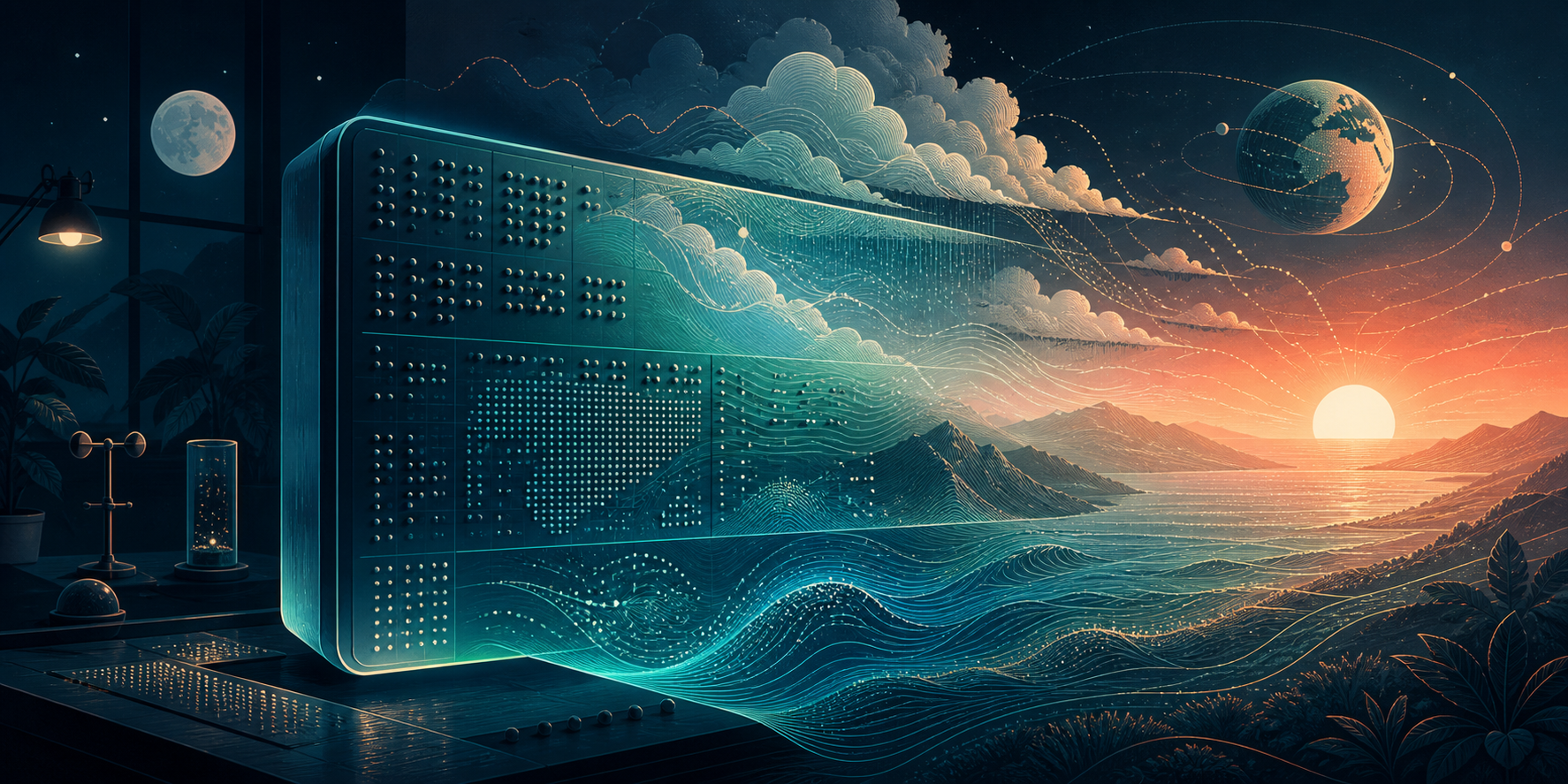
Most terminal weather tools answer a narrow question: what is the temperature now? linecast starts there, then treats the terminal as a small environmental instrument. Its six views cover weather, sunshine, the moon, tides, radar, and maps. The result is not merely a compact substitute for a website. It is an argument that a character grid can support continuous, exploratory information without becoming a pseudo-desktop.
That distinction matters. A static forecast is easy to print, but linecast also draws an hourly temperature curve, the Sun's daily arc, a shaded lunar disc, scrolling tide predictions, animated radar, vector streets, terrain, and an orthographic globe. Mouse and keyboard interaction coexist with Unix-shaped outputs: weather, sunshine, moon, and tides can emit JSON, while --oneline fits status bars and --print produces one stable frame. Piped output automatically becomes static.
A young project moving unusually fast
The project's public history is short and unusually legible. PyPI records version 1.0.0 on March 5, 2026, the same day GitHub records the repository's creation. By late August, upstream releases had reached 2.x. That pace explains both the breadth and the principal risk: this is a new tool whose interface and data integrations have been evolving quickly.
The implementation is pure Python and targets Python 3.10 or later. On macOS and Linux it advertises no runtime dependencies; Windows adds timezone and operating-system trust-store packages. More interesting than the packaging is the source strategy. linecast assembles free public services rather than requiring a user account or API key. Forecasts, alerts, tiles, routing, elevation, clouds, and tides therefore arrive from different providers, each with its own geography and failure modes. Convenience here is real, but it is built on a network of dependencies.
Tides make that tradeoff concrete. The project names dedicated sources for the United States, Canada, Queensland, and Hong Kong, then falls back to a global model elsewhere. That yields broad coverage, not uniform authority. Anyone making safety-critical decisions should still consult the relevant hydrographic or meteorological agency. linecast is excellent for orientation; it is not a promise that every coast has equivalent observations.
The terminal is part of the rendering stack
Dense terminal graphics depend on the emulator as much as the application. linecast uses Braille-pattern cells, color gradients, mouse events, and theme detection to squeeze more visual resolution from text. A modern GPU-backed emulator such as Rio is a natural companion: Rio uses a WebGPU rendering architecture and supports tabs, splits, themes, and configurable navigation. It gives linecast's animated and color-heavy views a capable canvas.
That pairing is optional, not a requirement. Existing terminals may work perfectly well, and switching emulators introduces another configuration surface plus platform-specific graphics behavior. Nerd Fonts are optional too; upstream documents an icon mode for them, while ordinary emoji remain available. The healthiest approach is incremental:
- begin with
linecast weatherin the terminal already in use; - try
--print,--oneline, or JSON before building automation; - evaluate radar and maps on the actual network and display where they will run;
- only tune fonts or adopt another emulator when a visible limitation justifies it.
Where it earns a place
The project is most persuasive when a terminal is already the working context. A developer can check an alert without shifting into a browser, place a terse condition in a status bar, or inspect daylight while coordinating across time zones. The map view goes further: upstream documents place search, route directions, street and terrain modes, live daylight shading, clouds, and a globe. These are substantial interactions, not ornamental ANSI art.
There is early evidence of attention beyond the package-manager catalog: the public GitHub project has accumulated stars and forks, while PyPI provides an independent distribution record. Those signals show interest, not durable adoption, and the project's age argues against stronger claims. The fair conclusion is narrower: linecast has already demonstrated that terminal-native environmental software can be cohesive rather than gimmicky.
Its best feature may be the boundary it preserves. It can be a live dashboard when a person is exploring, a single frame when output is redirected, or structured data when a script is listening. That respect for multiple modes makes the visual ambition useful. The terminal does not have to imitate a browser; it can become a compact observatory on its own terms.